
A Data‑Driven Guide for Businesses in Australia, US, UK, Canada & Europe
Packaging is more than a container – it’s a silent brand ambassador. In a world where e‑commerce, subscription services, and corporate gifting are booming, the box customers receive can shape perception and loyalty. The global packaging industry is valued at US$1.17 trillion in 2025 and is projected to reach US$1.63 trillion by 2033.
In the U.S. alone, the packaging market is worth $200 billion in 2024 and is forecast to grow to $250 billion by 2030. As packaging becomes a differentiator, businesses across Australia, North America, the UK and Europe must decide whether to invest in custom gift boxes or rely on pre‑made (stock) boxes.
This guide explains the differences, advantages, costs and regional considerations for both options. It draws on recent market data and surveys to help small businesses, medium‑sized companies, e‑commerce sellers and corporate brands make informed decisions.
Custom vs. Pre‑Made Gift Boxes: What They Are
Pre‑Made (Stock) Gift Boxes
Stock or pre‑made boxes are mass‑produced in standard sizes and shapes. They use a one‑size‑fits‑all strategy with limited colour options and minimal branding. Because they are printed in bulk, they are inexpensive and readily available, making them attractive for budget‑conscious or short‑notice orders. However, they offer little flexibility – the box’s dimensions, materials and artwork are predetermined.
Custom Gift Boxes
Custom gift boxes are designed specifically for a brand and its products. Everything can be tailored – size, shape, material, colour, printing and finishing. This versatility allows businesses to create packaging that tells their story, enhances the unboxing experience and protects products.For instance, custom boxes can include branded inserts or compartments to secure fragile items. These boxes are made to order, which means longer lead times and higher costs but also distinctive branding and design.
Why Packaging Matters: Consumer Insights
- Packaging influences buying decisions – About 72% of buyers say packaging design impacts purchase decisions, and 45% prefer buying from retailers that offer premium packaging.
- Sustainable packaging is becoming critical – 92% of shoppers say sustainability is important when choosing a brand, and 61% of e‑commerce shoppers cite sustainable packaging as the top factor influencing where they shop. 43% consider environmental impact when evaluating packaging, while 41% worry about waste.
- Unboxing affects loyalty – A 2025 e‑commerce survey found that shoppers prefer boxes over bags because they provide better protection (36%), can be reused (29%) and feel more eco‑friendly. Premium unboxing experiences with custom boxes, colourful filler material and branded details encourage repeat purchases and social‑media sharing.
These insights show that packaging is no longer an afterthought. It shapes first impressions, conveys values such as sustainability and can convert one‑time buyers into loyal customers.
Advantages of Custom Gift Boxes
- Brand differentiation and storytelling: Custom boxes allow unique colours, shapes, embossing, foil and finishes. They act as a “silent salesperson” that conveys brand identity, values and quality. For luxury or corporate gifting, they elevate the perceived value and create a memorable unboxing experience.
- Tailored protection and fit: Products with irregular shapes, fragile components or multiple items benefit from custom inserts or compartments that minimize damage and reduce the need for additional packing materials.
- Marketing and customer engagement: Branded packaging encourages social‑media sharing; consumers frequently post unboxing photos, which expands brand reach. Custom boxes also support promotions (coupons, QR codes, augmented reality) and can be reused by customers, extending brand visibility.
- Sustainability and material choice: Businesses can choose eco‑friendly materials (e.g., recycled cardboard, kraft paper) and printing methods. Many consumers are willing to pay more for sustainable packaging.
Versatility in ordering: With modern digital printing, low minimum order quantities are possible. Suppliers like UC Packages Australia (minimum 100 units) and Packola (no minimum order) enable small businesses to experiment with custom packaging.
Disadvantages of Custom Gift Boxes
- Higher cost: Custom boxes cost more than stock boxes because of design work, die cutting, specialized materials and small‑batch production. For instance, custom cardboard boxes typically cost US$0.70–$6 per unit, rigid boxes range from $1 to $200 per unit and folding cartons cost around $2.25 per unit. Additional costs include artwork design ($45–$50 000) and premium printing methods.
- Longer lead times: Designing, proofing and producing custom boxes can take from 7 to 14 business days or longer. Packlane ships most orders within 10 days; Packola typically ships within 10–12 business days.
- Complexity and resource investment: Creating custom packaging requires design expertise, decision‑making on materials/finishes and coordination with suppliers. Small businesses may need to allocate time and budget for these tasks.
- Inventory risk: Custom boxes are produced in specific quantities; ordering too many can lead to surplus inventory if product demand changes.
Advantages of Pre‑Made (Stock) Gift Boxes
- Lower cost and fast turnaround: Stock boxes are produced in bulk, so unit prices are low—often US$0.50–$2 per box. For example, a 6 × 6 × 6 in stock box costs $0.77 while a 10 × 10 × 10 in box costs $1.15.
- Immediate availability: Stock boxes are ready to ship and can be ordered quickly, making them ideal for startups, seasonal peaks or testing new products.
- Simplicity: Off‑the‑shelf boxes require minimal decision‑making. They are easy to assemble and store, which shortens supply chains and speeds up fulfillment.
- Budget flexibility: For subscription services or budget‑conscious brands, stock boxes keep packaging costs low. Businesses can allocate savings to marketing or product development.
- Can be lightly branded: Companies can still add stickers, tape or stamps to stock boxes to provide some branding without fully customized packaging.
Disadvantages of Pre‑Made Gift Boxes
- Limited customization: Standard sizes and colours restrict branding and may not fit products precisely.
- Generic appearance: Stock packaging rarely delivers a memorable unboxing experience; it may fail to evoke emotion or inspire social‑media sharing.
- Additional protective materials: For fragile products, stock boxes often require extra void fill (bubble wrap, peanuts), increasing costs and environmental impact.
- Missed marketing opportunities: Without customization, packaging cannot showcase brand values, sustainability credentials or promotional messages.
Cost Comparison: Custom vs. Stock Boxes
To illustrate typical cost differences, the following table summarizes representative unit prices. Custom box costs vary widely depending on size, materials, finish and order quantity. Stock box prices are more predictable but still vary by size and supplier.
| Packaging Type | Typical Cost per Unit (USD) | Source |
| Custom cardboard boxes | US$0.70–$6 per unit | Packhit (2025) |
| Custom rigid boxes | US$1–$200 per unit (luxury rigid boxes skew high) | Packhit (2025) |
| Custom folding cartons | ≈US$2.25 per unit | Packhit (2025) |
| Custom packaging materials | Cardboard (US$0.91–$12.86 per unit), Corrugated fiberboard (US$0.15–$16.51), Rigid board (US$17–$200) | Packhit (2025) |
| Stock box (6 × 6 × 6 in) | US$0.77 per box | Cumberland Container (2025) |
| Stock box (10 × 10 × 10 in) | US$1.15 per box | Cumberland Container (2025) |
| Stock box (12 × 12 × 12 in) | US$1.68 per box | Cumberland Container (2025) |
| Packlane custom shipping box (12 × 12 × 12 in) | US$5.53 per box when ordering 200 units | Growth Marketing Pro (2024–2025) |
| Packola custom shipping box (12 × 12 × 12 in) | US$5.16 per box when ordering 250 units | Growth Marketing Pro (2024–2025) |
| Sticker Mule mailer (10 × 13 in) | US$2.08 per unit for 200 mailers | Growth Marketing Pro (2024–2025) |
| Brand in Color boxes | Starting at US$1 per box with a minimum order of 25 boxes and 3‑day shipping | Growth Marketing Pro (2024–2025) |
Cost comparison chart
The below chart visualizes typical costs across custom and stock options. Values represent mid‑ranges or representative examples, not absolute limits.
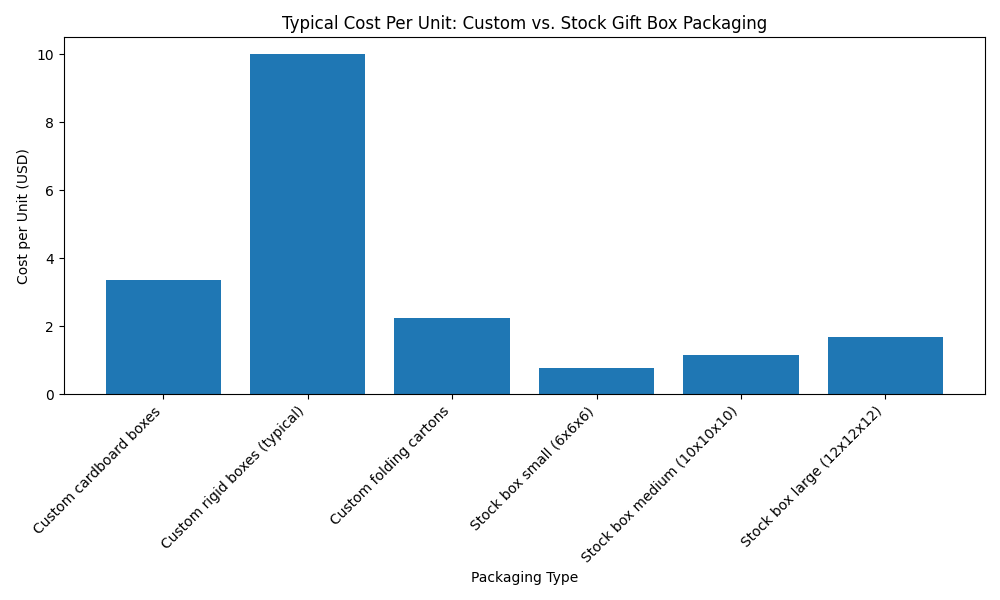
The data show that stock boxes remain the most affordable choice, while custom cardboard and folding cartons cost several dollars per unit on average. Rigid boxes can be expensive because they use durable materials and premium finishes. However, using digital printing and ordering in bulk can reduce the cost per unit.
Packaging Market Trends and Sustainability
- Gift boxes market growth: The global gift boxes market is expected to reach US$2.3 billion by 2025 with a 6.4% CAGR through 2035. Growth is driven by demand for sustainable, upper‑end gift packaging and consumers’ interest in customized and luxury presentation.
- Custom boxes market expansion: The custom boxes market is projected to reach US$52.687 billion in 2025 and US$77.243 billion by 2035 (CAGR 3.9%). Expansion is fueled by e‑commerce growth, personalized branding and demand for eco‑friendly materials.
- Sustainable packaging momentum: Sustainable products grow 2.7 times faster than traditional goods. Governments are implementing policies such as the EU’s Packaging Waste Directive and California’s Plastic Pollution Prevention Act. High‑profile brands like Estée Lauder and Gucci have adopted recyclable, corrugated gift boxes.
- Australian gift packaging: Australia’s gift packaging market is projected to grow at a 3.8% CAGR (2023–2029). About 36% of Australian consumers are willing to pay more for personalized products, and 98% of 18–29‑year‑olds use social media, creating demand for visually appealing packaging.
- Consumer willingness to wait for sustainability: In a 2025 survey, approximately 75% of e‑commerce shoppers said they would accept longer delivery times to reduce environmental impact.
Consumer preference chart
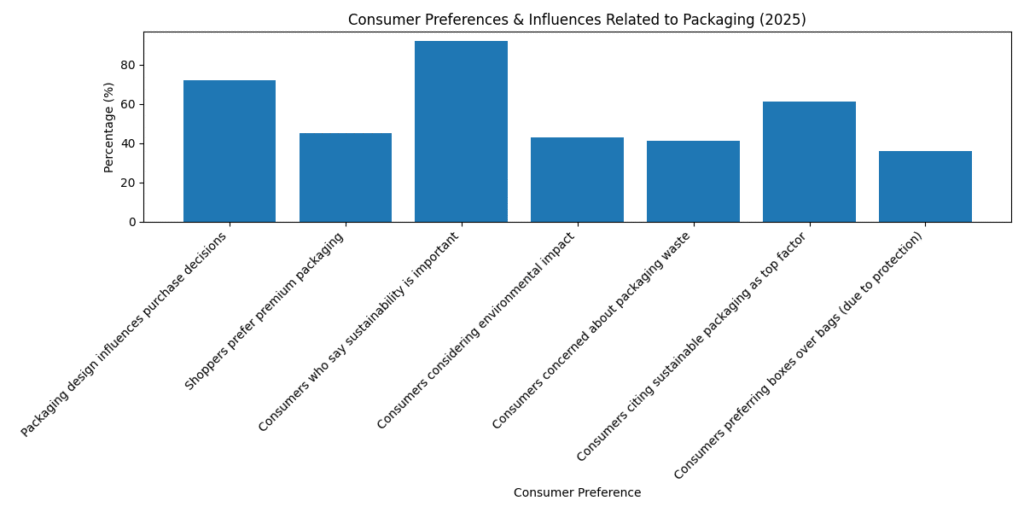
The chart summarises survey findings from 2024–2025. Packaging design, premium materials and sustainability strongly influence purchasing behaviour. A majority of consumers consider sustainability important, while significant numbers prefer premium packaging or are worried about waste. These preferences support investing in packaging that communicates brand values and environmental stewardship.
Regional Considerations and Suppliers
Australia
- Market trends: Australia’s gift packaging market is growing due to rising online sales and an emphasis on personalised and customised products ( 6wresearch.com ). Social‑media‑savvy consumers drive demand for visually appealing packaging.
- Local supplier – Pakko: Pakko manufactures Australian‑made cardboard packaging with no minimum order quantity, quick turnaround times and eco‑friendly FSC‑approved materials. As a local manufacturer, Pakko supports short supply chains and reduces carbon footprint.
- UC Packages: UC Packages offers custom gift boxes worldwide. Their Australian page highlights quick turnaround, competitive pricing, and eco‑friendly materials such as cardboard and kraft paper. The company also notes that 72% of American consumers say packaging design influences buying decisions, emphasizing the marketing value of custom boxes.
Recommendation: Australian businesses seeking eco‑friendly custom packaging should consider Pakko for local production or UC Packages for a wider range of materials and finishes. Stock boxes are available from local retailers for cost‑sensitive use cases, but custom packaging better serves premium or corporate gifting.
United States & Canada
- Market size: The U.S. packaging market is $200 billion with strong growth expected. E‑commerce and branding fuel demand for custom boxes, and the U.S. leads in packaging design services (over 35% share).
- Suppliers:
- Packlane – Offers mailer, folding carton and shipping boxes with a custom design lab, live preview and instant quotes. Orders generally ship within 10 days, and a standard 12 × 12 × 12 in custom shipping box costs $5.53 per unit when ordering 200 boxes.
- Packola – Provides an online 3D design studio with no minimum order. Most orders ship within 10–12 business days; a 12 × 12 × 12 in custom shipping box costs $5.16 per unit for 250 boxes.
- Arka – Minimum order 10 units, various box types (mailer, shipping, cartons), integration with e‑commerce platforms and 30‑day money‑back guarantee.
- Sticker Mule – Specialises in custom poly mailers and stickers with free proofs, free shipping and four‑day delivery; minimum order 10 mailers and example price $2.08 per unit for 200 mailers.
- Brand in Color – Offers shipping, mailer and pizza boxes starting at $1 per box with a minimum order of 25 boxes and three‑day shipping.
- Canada: Custom Boxes Canada provides premium packaging, no minimum order quantity, free design support, no die and plate charges and fast turnaround times. This makes it attractive for Canadian businesses seeking local production. UC Packages also serves in Canada, offering multiple materials and wholesale pricing.
Recommendation: U.S. and Canadian businesses should leverage digital design tools and low minimums offered by Packlane, Packola and Arka to test custom packaging. For simple shipping needs, stock boxes from suppliers like Uline or local packaging distributors keep costs low. UC Packages is a strong option for companies wanting flexible customization, fast turnaround and eco‑friendly materials across North America.
United Kingdom
- Market context: UK consumers are highly conscious of sustainability and luxury presentation. The EU and UK implement strict packaging waste regulations, encouraging recyclable and compostable materials.
- Suppliers:
- Plus Printers UK – Offers advanced printing methods, easy online ordering, free shipping within the UK, low minimum order policies and fast, reliable delivery. They specialise in luxury gift boxes and corporate packaging.
- UC Packages – The company provides personalized gift boxes with materials such as velvet, kraft, glossy paperboard and corrugated cardboard, along with luxury finishing options. The page emphasises that these boxes increase brand identity and customer satisfaction.
Recommendation: UK businesses looking for premium packaging should explore Plus Printers for domestic production and free UK shipping. UC Packages supplies high‑quality custom gift boxes for companies wanting to combine luxury finishes with sustainable materials.
Europe (Continental)
- Market dynamics: Europe has stringent environmental norms and a strong push towards recyclable or reusable packaging. Demand is driven by luxury branding and circular economy practices.
- Suppliers:
- Packhelp – A European packaging platform targeting small and medium retailers. It offers mailer and shipping boxes in various sizes with a minimum order of 30 boxes and a production time of 14 days. Their user‑friendly design tool enables businesses to customise boxes without design experience.
- UC Packages – Offers worldwide custom gift boxes with quick turnaround and multiple materials. Their services suit European companies seeking U.S./UK‑style luxury packaging while meeting EU sustainability standards.
Recommendation: Small and mid‑size European retailers should consider Packhelp for accessible minimums and local production. For complex projects or luxury finishes, UC Packages provides more variety and international expertise.
Decision Matrix: When to Choose Custom vs. Stock
| Business Scenario | Choose Custom Gift Boxes | Choose Pre‑Made (Stock) Boxes |
| Premium branding or luxury products | ✓ Tailor materials, finishes and design to create a memorable unboxing experience. | ─ |
| Corporate gifting or limited‑edition campaigns | ✓ Showcase company logos and messages; customise inserts for gifts or promotional items. | ─ |
| Delicate or irregularly shaped products | ✓ Design inserts or compartments for a secure fit and reduce damage. | ─ |
| Strong sustainability goals | ✓ Specify eco‑friendly materials, minimalist design and reusable options; communicate sustainability clearly on packaging. | ✓ If using FSC‑certified stock boxes with minimal printing. |
| High order volumes with predictable designs | ✓ Custom orders are more economical at large quantities and offer per‑unit cost savings. | ✓ If design doesn’t need to change and budgets are tight; stock boxes can handle large volumes. |
| Budget constraints or rapid fulfilment needs | ─ | ✓ Stock boxes are inexpensive, readily available and ideal for testing new products. |
| Product assortment with varying sizes | ✓ Order different custom sizes to reduce void space and shipping costs; or use a modular system. | ✓ Use a few standard stock sizes with filler materials to handle varied products. |
| Small or emerging brand | ✓ Start with custom mailers or inserts for flagship products to build identity gradually. | ✓ Use stock boxes with branded stickers or tape; upgrade to custom as revenue grows. |
Implementation Steps for Custom Packaging
- Define objectives and budget: Clarify whether you need luxury presentation, product protection, sustainability or a combination. Allocate a realistic budget based on the cost ranges discussed above.
- Choose box type and material: Select from mailer boxes, folding cartons, rigid boxes or shipping boxes. Consider eco‑friendly materials such as recycled cardboard, kraft paper or corrugated board.
- Design the artwork: Work with a designer or use online design labs (e.g., Packlane, Packola). Ensure colours, fonts and logos align with brand guidelines. Create an unboxing narrative and include sustainability icons if appropriate.
- Request prototypes and quotes: Most suppliers provide digital proofs or physical samples. Compare quotes from multiple vendors, factoring in minimum order quantities, lead times and shipping costs.
- Place the order and plan inventory: Order slightly more than expected needs to account for damaged boxes but avoid excess inventory. For seasonal campaigns, consider just‑in‑time production or smaller batches.
- Test and collect feedback: Send out initial shipments and gather customer feedback on packaging quality, aesthetics and unboxing experience. Use surveys, social‑media monitoring or direct feedback.
- Iterate and optimize: Refine the design, materials and supplier relationships based on feedback and sales metrics. Gradually scale up custom packaging for more product lines or special editions.
Final Opinion – What should you go with?
Choosing between custom gift boxes and pre‑made stock boxes depends on your brand’s priorities, budget, timeline and target audience. Custom boxes offer unmatched branding, protection and sustainability options but come with higher costs and longer lead times. Stock boxes are quick, affordable and functional but lack the wow factor that modern consumers crave. Data shows that packaging design, sustainability, and unboxing experiences significantly influence purchasing decisions.
For businesses in Australia, the U.S., Canada, the UK, and Europe, a hybrid approach often works best: use stock boxes for low‑cost efficiency and custom gift boxes for flagship products, corporate giftin,g or subscription services. Suppliers like UC Packages provide flexible options across regions, allowing businesses to tailor packaging without excessive costs. By aligning packaging with brand values and consumer expectations, companies can transform an everyday box into a powerful marketing tool.